
Free and open datasets & how to access them
Unlock the potential of free, open datasets with our latest guide. Learn about key platforms, best practices, and strategic applications to enhance your project
 Brogan RenshawDirector and Innovation Lead, Firewire Digital
On this page
Most guides to free datasets stop at “here’s where to find them.” That’s the least valuable thing you can do with open data. The real opportunity, and the one almost nobody writing about this acts on, is using free datasets as raw material for original research: the kind of data-led content that earns links and gets cited in AI answers, where rehashed opinion never will.
That’s the lens this guide takes. Yes, we’ll cover the best free and open data sources (government portals, academic repositories, Kaggle, the cloud marketplaces) and how to judge their quality. But the point isn’t to find a number to drop in a slide. It’s to turn public data into a linkable, citable asset that pulls organic traffic and authority back to your site, which is exactly how we use it for clients.
- Government portals like Data.gov and World Bank Open Data provide free access to comprehensive economic, demographic, and industry statistics that typically cost thousands through commercial research firms.
- Cross-validation between multiple free data sources ensures reliability, while systematic quality assessment prevents costly decisions based on outdated or inaccurate information.
- Free datasets serve as powerful foundations for content marketing, enabling businesses to create authoritative, data-driven thought leadership content that drives organic search visibility.
- Cloud-based platforms and API access to government data are making real-time business intelligence possible without expensive infrastructure or subscription costs.
- Strategic application of free data for market research and competitive analysis can accelerate decision-making while reducing research costs by up to 80% compared to commercial alternatives.
What constitutes free data
Free data, often called open data, encompasses datasets that are freely available for anyone to access, use, and share without financial barriers or restrictive licensing. These resources span an extensive range of categories, from government-published statistics and economic indicators to scientific research findings and social demographics.
The scope of free, public datasets continues to expand as governments worldwide embrace transparency initiatives and organisations recognise the value of data sharing. This growth creates opportunities for businesses to access information that supports everything from market entry decisions to customer behaviour analysis.
Business advantages of open access data
Organisations that can effectively utilise these resources gain access to comprehensive market insights, industry benchmarks, and trend analysis that inform critical business decisions. You can create opportunities to identify market gaps, understand demographic shifts, and monitor competitive landscapes.
Moreover, free data enables rapid hypothesis testing and market validation. Rather than commissioning expensive research studies, you can query existing datasets to validate assumptions or explore new business opportunities. This approach accelerates decision-making while reducing the risk associated with major strategic initiatives.
At Firewire, we help businesses turn open data into content that ranks and earns links. The pattern we see in our data-driven marketing campaigns: the organisations winning with free data aren’t the ones with the most dashboards, they’re the ones turning public datasets into original research their market (and AI engines) cite.
Quality considerations for open data
Not all datasets offer the same level of accuracy, completeness, or timeliness, making source assessment a vital component of effective data utilisation.
We suggest developing systematic approaches to evaluating data credibility, examining factors such as the data scientists publishing the data, the methodology used to find the data, and the frequency of updates.
Government sources like national statistical offices typically provide highly reliable data, while academic institutions often offer rigorous, peer-reviewed datasets.
Platforms for accessing free data
Today, numerous platforms offer high-quality, easily accessible datasets. Understanding the strengths and specialisations of different platforms helps you identify the most appropriate sources for your specific business needs.
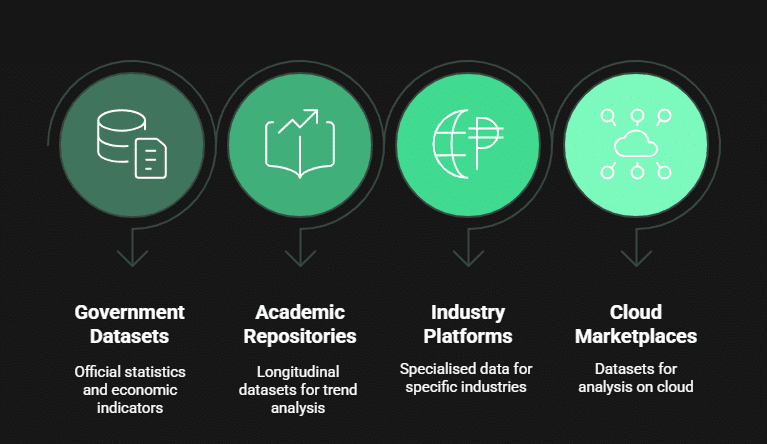
Government open datasets
Government open data portals represent some of the most comprehensive and reliable sources of free information available to businesses and researchers. Data.gov.au provides Australian government data spanning federal, state, and local levels. This platform provides access to official statistics, economic indicators, education parameters, demographic data, and regulatory information, forming the foundation of many business intelligence efforts.
For businesses operating internationally, exploring similar government portals in your target markets provides valuable local insights, such as the European Union Open Data Portal or Data.gov, the United States’ primary open data portal.
Academic and research data repositories
Academic institutions and research organisations contribute significantly to the landscape of freely available data, particularly in areas related to social sciences, environmental research, and economic analysis. These catalogues often provide longitudinal datasets that support trend analysis and long-term strategic planning.
Harvard Dataverse features research data across multiple disciplines, offering access to datasets used in published academic studies³. Similarly, the Inter-university Consortium for Political and Social Research (ICPSR) maintains one of the world’s largest archives of social science data⁴.
Specialised industry data platforms
Beyond government and academic sources, several specialised platforms focus on specific industries or data types.
The Kaggle site hosts a vast community-driven library of free data sets across topics including finance, retail, healthcare, and technology. For businesses focused on global markets, the World Bank Open Data platform provides economic development indicators, financial statistics, and progress metrics on international development projects. Tableau Public offers both data visualisation tools and access to publicly shared datasets.
Emerging cloud-based data marketplaces
Cloud computing platforms increasingly offer data marketplace services that include both premium and free datasets. AWS Open Data Program makes high-value datasets available for analysis on Amazon Web Services infrastructure. Google Dataset Search functions as a search engine specifically designed to help users discover datasets across the internet.
Turn open data into links and AI citations
Here’s the move most businesses miss. Open datasets aren’t just inputs for your own decisions; they’re the cheapest source of genuinely original content you have. Original research is the single most-cited content type in AI answers (Onely found 67% of ChatGPT’s top citations go to original research), and it earns editorial links that buying never will. A public dataset, analysed for an angle nobody else has published, becomes a linkable asset.
The method we run:
- Pick a question your audience actually argues about, then find the open dataset that answers it (the ABS, Data.gov.au, World Bank, a Kaggle set).
- Profile the data with AI to find the story. Drop the dataset into a model and have it surface the outliers, the trend and the counter-intuitive cut, the thing worth publishing, far faster than eyeballing a spreadsheet. The model proposes candidate angles; a human checks the maths and picks the one that’s both true and interesting.
- Cross-validate the headline figure against a second source (see the callout above), because the number you publish has to survive scrutiny from the journalists and AI engines you want citing it.
- Publish it as a clear, well-structured original-research piece, data visible, method stated, the figure quotable, then pitch it to the publishers in your niche.
That’s how a free dataset turns into referring domains and AI citations instead of a stat buried in a deck. The dataset is free; the angle is the work.
Future trends in open data accessibility
The landscape of free data continues to evolve rapidly. Here are the key emerging trends we are seeing in the landscape:
Government transparency initiatives
- Policymakers worldwide are expanding their open data initiatives, driven by transparency mandates, citizen engagement objectives, and economic development goals. API-based data access and real-time data feeds are making government data more accessible and useful for business applications.
Private sector data sharing
- Private organisations increasingly recognise the strategic value of selective data sharing. Trade associations are developing shared data repositories that provide members access to aggregated industry insights while preserving competitive sensitivities. Technology companies are expanding their open data offerings as part of broader platform strategies.
Technological enablement
- Advances in data processing and analysis technologies are making free data more accessible and useful for business applications. Cloud computing platforms are reducing the technical barriers to working with large datasets. At the same time, AI and machine learning tools enable businesses to extract insights from free data sources that would previously have required specialised expertise or expensive consulting services.
Using free data sets for competitive advantage
Success in leveraging free data requires more than simply knowing where to find information. It demands systematic approaches to data quality assessment, strategic thinking about how data supports business objectives, and consistent methodologies for transforming raw information into actionable insights.
At Firewire, the highest-return use of open data we see isn’t internal reporting, it’s original-research content that compounds: each data-led piece earns links and citations that keep paying long after it’s published.
Whether you’re supporting content marketing, informing a market-entry decision, or building the original research that makes your brand the cited source, free data is the foundation, if you turn it into something worth linking to. Contact our team to discuss how we’d turn open data into a citable asset for your next campaign.
Written by
Brogan RenshawDirector and Innovation Lead, Firewire Digital
Brogan Renshaw founded Firewire Digital in 2017 and still spends most of his time close to the work: search strategy, SEO, paid media, AI search and figuring out where growth is actually getting stuck. He also co-founded the Edge of Search conference.



Want this read on your own account?
Be found first. Be chosen naturally.
Thirty minutes on your own data, pulled live and walked through together, naming the three moves worth making first.