
On this page
- Breaking down how programmatic advertising works
- Navigating programmatic advertising platforms
- The programmatic advertising process in 6 steps
- Types of programmatic advertising
- Advanced targeting in programmatic advertising
- Format diversity in programmatic advertising
- Examples of programmatic advertising
- Is Google Ads programmatic advertising?
- Programmatic marketing in 2026: what’s changed
- Creating effective programmatic ad campaigns
- Programmatic advertising costs
- Benefits of programmatic advertising
- Frequently asked questions
- Partner with experts for programmatic success
Programmatic advertising happens in less than 100 milliseconds, faster than the blink of an eye.
Programmatic advertising is the automated buying and selling of digital ad space in real time, using software and data instead of manual negotiation. It has transformed digital advertising, and in 2026 the ground has shifted again: Google kept third-party cookies and retired its Privacy Sandbox, while CTV, retail media and AI bidding reshape where ad spend and ad impressions go. Here’s how programmatic advertising works, end to end, and what it costs to run a programmatic advertising campaign this year.
For established brands managing significant marketing budgets, understanding how programmatic advertising works is essential. It’s how you maximise ROI and hold a competitive edge. At Firewire, we’ve helped businesses transform their digital advertising by using programmatic advertising to drive measurable results. This guide will demystify programmatic ad buying, explore its core technologies, and provide actionable insights to help you implement effective campaigns.
- Programmatic advertising automates media buying through an interconnected ecosystem of DSPs, SSPs, ad exchanges, and DMPs, delivering greater efficiency and targeting precision than traditional methods.
- Advanced targeting capabilities allow you to reach precisely defined audience segments using demographic, behavioural, contextual, and lookalike modelling strategies that drive higher conversion rates.
- Programmatic extends beyond display banners to include video, native, audio, connected TV, and digital out-of-home formats, enabling comprehensive multi-channel campaigns.
- Effective implementation requires clear campaign objectives, strategic audience development, and continuous measurement against KPIs that align with your business goals.
- Costs vary based on pricing models (CPM, CPC, CPA), data usage, technology fees, and creative complexity, with proper optimisation driving significant ROI improvements.
Breaking down how programmatic advertising works
Today, programmatic advertising enables advertisers to purchase ad inventory across thousands of websites simultaneously using automated systems. This shift has transformed media buying from a relationship-based process to a data-driven, algorithmic approach that delivers greater efficiency and targeting precision.
While traditional banner ads and direct publisher relationships still have their place, programmatic marketing offers unparalleled scale and efficiency. The technology allows your digital marketing strategy to adapt in real time, responding to performance data and audience behaviours to optimise ad spend across multiple channels.
The programmatic advertising process relies on an interconnected ecosystem of platforms and technologies working in concert to deliver the right ad to the right person at the right time. These are:
Demand-side platforms (DSPs)
Demand side platforms are sophisticated tools that allow advertisers to buy ad space and ad inventory across multiple ad exchanges through a single interface, automating the entire ad buying process. These platforms enable you to:
- Set targeting parameters based on demographics, interests, and behaviours
- Establish budget limits and bidding strategies
- Access inventory across thousands of websites, apps, and platforms
- Monitor campaign performance in real-time
Popular DSPs include Google Display & Video 360, The Trade Desk, and MediaMath. These platforms serve as your command centre for programmatic campaigns, making managing complex media buying strategies easier.
Supply-side platforms (SSPs)
On the publisher side, supply side platforms help website owners and app developers sell ad space efficiently. SSPs connect to ad exchanges and DSPs, creating competition for available ad inventory and maximising revenue for publishers who sell ad space programmatically. Major SSPs include Google Ad Manager, Xandr, and PubMatic.
Ad exchanges
Ad exchanges function as digital marketplaces where programmatic advertising transactions occur. These platforms facilitate real-time bidding (RTB) auctions, connecting buyers (through DSPs) with sellers (through SSPs). The Google Ad Exchange (now part of Google Ad Manager) is one of the largest, but multiple ad exchanges operate globally, each with unique inventory and publisher relationships.
Ad networks
While sometimes confused with ad exchanges, ad networks serve a different purpose in the programmatic ecosystem. Ad networks aggregate inventory from multiple publishers and sell it to advertisers, often focusing on specific niches or formats. These networks typically offer less transparency than exchanges but can provide access to curated inventory pools. Many traditional ad networks have evolved to incorporate programmatic capabilities, blurring the lines between networks and exchanges.
Data management platforms (DMPs)
Data management platforms DMPs collect, organise, and activate audience data from various sources, helping you build detailed target audience segments based on browsing behaviour, purchase history, and demographic information. Together with DSPs and SSPs, they complete the engine behind every programmatic advertising campaign. This audience data powers the precise targeting that makes programmatic advertising so effective. Leading DMPs include Salesforce DMP, Oracle BlueKai, and Adobe Audience Manager.
Navigating programmatic advertising platforms
The market for programmatic advertising platforms has expanded significantly, giving advertisers many options to consider when implementing their programmatic strategy. Each platform offers different capabilities, inventory access, and pricing models.
Major programmatic advertising platforms
Several key players dominate the programmatic landscape:
- Google Marketing Platform combines analytics and advertising capabilities, including Display & Video 360 for programmatic buying. Its integration with Google’s vast ecosystem makes it a powerful choice for many advertisers.
- The Trade Desk is a leading independent DSP known for its sophisticated targeting capabilities and access to premium inventory across display, video, audio, and connected TV.
- MediaMath offers an enterprise-grade programmatic solution with advanced audience targeting and strong fraud prevention measures.
- Amazon DSP provides unique access to Amazon’s first-party consumer data and inventory across Amazon properties and third-party sites.
- Xandr (formerly AppNexus) delivers strong performance for advertisers and publishers with transparent auction dynamics and robust analytics.
Platform selection criteria
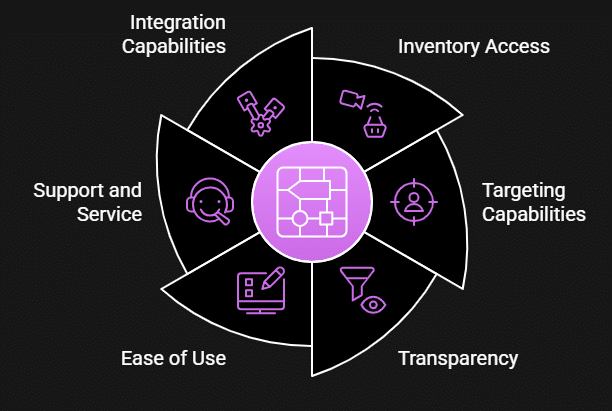
When evaluating programmatic advertising platforms, consider these factors:
- Inventory access: Assess which platforms provide access to the websites, apps, and channels your target audience frequents.
- Targeting capabilities: Compare the data sources, audience segmentation tools, and each platform’s targeting options.
- Transparency: Look for platforms that provide clear insights into where your ads appear, auction dynamics, and fee structures.
- Ease of use: Consider the interface, workflow, and technical requirements for managing campaigns effectively.
- Support and service: Evaluate the level of customer support, training resources, and strategic guidance available.
- Integration capabilities: Check how well the platform connects with your existing marketing tools and technology stack.
For many businesses, the best approach involves working with multiple complementary platforms rather than relying on a single solution. This multi-platform strategy provides broader reach and lets you draw on the unique strengths of different programmatic advertising platforms.
The programmatic advertising process in 6 steps
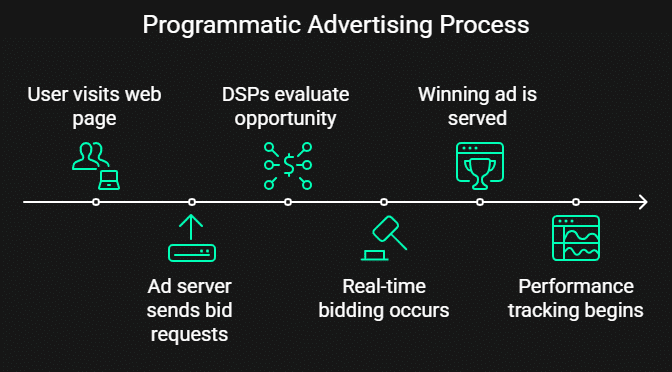
How does programmatic advertising work in practice? Let’s break down the process step by step:
- A user visits a web page. When someone navigates to a website with ad space available, the page begins to load, triggering the programmatic process.
- The publisher's ad server sends bid requests. The website's supply-side platform broadcasts information about the available ad impression, the user, and the context to multiple ad exchanges.
- DSPs evaluate the opportunity. Using the advertiser's targeting criteria and bidding parameters, demand-side platforms decide whether to bid on the impression and how much to offer.
- Real-time bidding occurs. In milliseconds, an auction occurs among interested advertisers. The highest bidder wins the opportunity to display their ad, though factors beyond price (like ad relevance) may also influence the outcome.
- The winning ad is served. The selected ad appears on the web page before the page finishes loading, making it seamless for the user.
- Performance tracking begins. The advertiser tracks impressions, clicks, and conversions, generating data for future bidding strategies and campaign optimisations.
Programmatic advertising happens in less than 100 milliseconds, faster than the blink of an eye. The technology’s speed and efficiency allow for unprecedented scale in digital advertising operations.
When you buy ad space programmatically, you’re not just purchasing a spot on a specific website; you’re buying access to your target audience wherever they appear online. This audience-first approach represents a fundamental shift from traditional media buying, focusing primarily on securing placement on specific websites or publications.
Types of programmatic advertising
Programmatic advertising encompasses several distinct models, each suited to different marketing objectives and campaign requirements:
Real-time bidding (RTB)
Real-time bidding (RTB) is the most common form of programmatic advertising, in which ad impressions are auctioned instantly. RTB offers flexibility and efficiency but provides fewer guarantees about where your ads will appear. This approach works well for performance-focused campaigns with clearly defined target audience segments.
Open RTB auctions give you access to the broadest range of inventory but typically come with less control over brand safety and context. However, advances in targeting and brand safety tools have made open exchanges increasingly viable for brand campaigns.
Programmatic direct
Programmatic direct (also called programmatic guaranteed) combines automation with the certainty of traditional direct buys. Advertisers negotiate directly with publishers for guaranteed ad placements but use programmatic technology to streamline delivery and optimisation. This approach is ideal for securing premium inventory on high-value sites where brand safety and context are paramount.
With programmatic direct, you reserve specific ad impressions in advance, often at a fixed CPM rate. This model works well for campaigns where predictable delivery and premium placement are more important than cost efficiency.
Preferred deals
Sitting between RTB and programmatic direct, preferred deals give advertisers first access to specific inventory before it becomes available in open auctions. These arrangements offer more transparency and control than open exchanges while maintaining some of the flexibility of auction-based buying.
You negotiate a fixed price with a publisher without the guaranteed programmatic direct volume in a preferred deal. This gives you priority access to inventory at an agreed rate, but you only pay when your ads run.
Private marketplaces (PMPs)
Private marketplaces are invitation-only RTB environments where select advertisers can bid on premium inventory from specific publishers. PMPs offer greater transparency and brand safety than open exchanges while keeping the efficiency of programmatic technology.
Private marketplaces work particularly well for advertisers concerned about brand safety or those wanting to access premium inventory that isn’t available through open exchanges. Many publishers reserve their most valuable ad space for PMP deals with trusted advertisers.
Advanced targeting in programmatic advertising
The true power of programmatic advertising lies in its sophisticated targeting capabilities. By combining various data sources, you can reach precisely defined audience segments across the digital advertising space:
Demographic targeting
Basic targeting parameters include age, gender, income, education, and geography. These foundational elements help ensure your advertising inventory is shown to relevant users based on fundamental characteristics.
Behavioural targeting
Behavioural targeting examines users’ online activities, such as websites visited, searches performed, and products viewed. This approach allows you to reach people who have demonstrated interest in topics related to your offerings.
This targeting method is particularly valuable for finding users in active buying cycles. For example, a traveller researching Bali vacations can be shown relevant hotel offers, while someone reading automotive reviews might see ads for local dealerships.
Contextual targeting
Rather than focusing on the user, contextual targeting considers the web page’s content where the ad appears. This approach ensures your ads display alongside relevant content, enhancing receptivity and engagement while addressing privacy concerns associated with user tracking.
Contextual targeting is experiencing a renaissance, and an important 2026 correction: third-party cookies did not go away. Google abandoned cookie deprecation and, in October 2025, retired its entire Privacy Sandbox suite (including the Topics API and Protected Audience API), with the UK competition regulator releasing Google from its commitments (AdExchanger). Cookies remain available in Chrome, but roughly half of web traffic (Safari, Firefox) is already cookieless, so the smart toolkit diversified anyway: first-party data, contextual targeting (spend up ~32% year on year), alternative IDs like UID2, and data clean rooms.
Modern contextual solutions use AI to understand page content beyond simple keywords, allowing sophisticated matching between ad campaigns and editorial environments without relying on user tracking at all.
Retargeting
Retargeting involves showing ads to users who have previously visited your website or interacted with your brand. This highly effective approach keeps your brand top-of-mind and encourages users to return and complete desired actions.
The most sophisticated retargeting strategies use sequential messaging that evolves based on user behaviour. For example, a user who abandoned a shopping cart might initially see a reminder ad, followed by a discount offer if they don’t convert within a specific time frame.
Cross-device targeting
Modern consumers move between devices throughout their day. Cross-device targeting helps you maintain consistent messaging as users switch from smartphones to laptops to tablets. This approach relies on deterministic matching (when users log into the same accounts on different devices) or probabilistic matching (using algorithms to infer relationships between devices).
Lookalike audiences
Lookalike modelling identifies users who share characteristics with your existing customers, expanding your reach to new prospects with high conversion potential. This technique uses machine learning to identify patterns and similarities across large datasets.
For instance, if your best customers tend to visit specific types of websites, have particular interests, or exhibit certain online behaviours, lookalike modelling can find users with similar patterns who haven’t yet engaged with your brand.
Format diversity in programmatic advertising
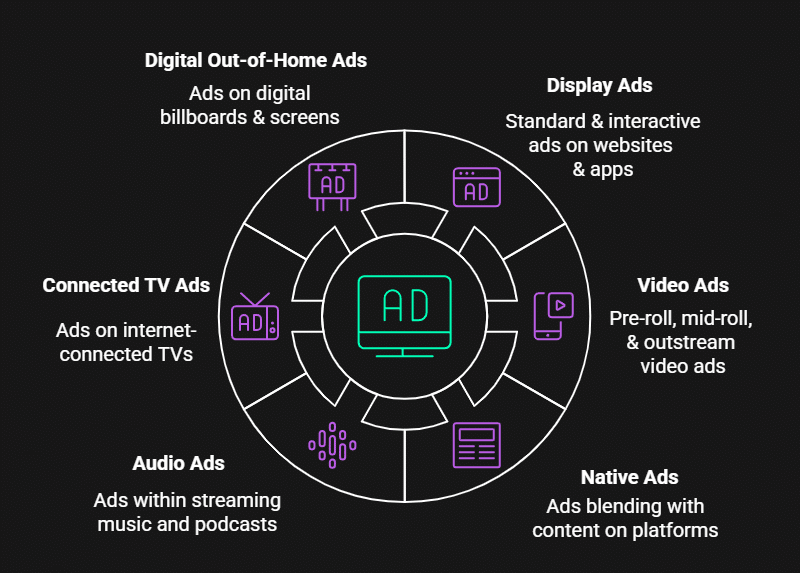
Programmatic media buying extends far beyond traditional display banners. Today’s programmatic advertising encompasses a wide range of creative formats, each with unique advantages:
Display ads
Standard display ads remain the foundation of many programmatic campaigns. They appear in designated placements across websites and mobile apps, including familiar formats like rectangles, leaderboards, and skyscrapers.
Modern display ads have evolved from static images to include interactive elements, animations, and dynamic content that adjusts based on user data. HTML5 technology has enabled richer experiences within standard placements.
Video ads
Video ads have seen explosive growth in programmatic channels. Formats include pre-roll (before content), mid-roll (during content), outstream (within editorial content), and in-banner video ads.
Programmatic video ads benefit from precise targeting and real-time optimisation. They allow you to reach specific audiences with engaging video content across a wide range of publishers. The ability to buy video ads programmatically has democratised access to video inventory that was once only available through direct publisher relationships.
Native ads
Native advertising matches the form and function of the platforms on which it appears. These ads blend seamlessly with surrounding content, often appearing as “recommended articles” or “sponsored content.”
Programmatic native ads maintain this contextual integration while adding the efficiency of automated buying. They typically see higher engagement rates than standard display ads because they’re less disruptive to the user experience.
Audio ads
Programmatic audio enables advertisers to place ads within streaming music services, podcasts, and digital radio. This format reaches audiences during screenless moments, making it effective for branding campaigns.
Connected TV (CTV)
Connected TV advertising targets viewers watching content on internet-connected televisions and devices (like Roku, Apple TV, or smart TVs). This rapidly growing format combines the impact of traditional TV with the targeting precision of programmatic advertising.
Digital out-of-home (DOOH)
Programmatic DOOH applies automated buying to digital billboards and screens in public spaces. While still emerging, this technology allows advertisers to adjust messaging based on factors like time of day, weather, or local events.
Examples of programmatic advertising
Three worked scenarios show how a programmatic ad actually gets bought and served:
Example 1: RTB display retargeting
A shopper abandons a cart on an ecommerce site. The retailer’s DSP holds their anonymised ID in a retargeting list. When that shopper later loads a news site, the publisher’s SSP broadcasts the impression, the DSP recognises the ID and bids, wins the auction in milliseconds, and serves a programmatic ad showing the abandoned product, often with an incentive. The whole transaction completes before the page finishes loading.
Example 2: Programmatic CTV
A furniture brand wants living rooms, not just browsers. Through a DSP connected to streaming inventory (via private marketplace deals), it buys 30-second spots shown to households in target postcodes watching ad-supported streaming. The brand gets television’s impact with programmatic’s household-level targeting and frequency capping.
Example 3: Programmatic digital out-of-home
A beverage company sets a rule: when the temperature passes 28°C, its programmatic ad buys digital billboard screens near beaches and transit hubs. The creative, the trigger and the buy all run automatically, with no phone calls to outdoor media owners required.
Is Google Ads programmatic advertising?
The short answer: partly. Google Ads uses automated, auction-based buying, but within Google’s own walled garden, not the open programmatic exchanges. True open-web programmatic buying through Google means Display & Video 360 (DV360), Google’s enterprise DSP.
- Is Meta (Facebook/Instagram) programmatic? Same distinction: automated auctions inside a walled garden, not open-exchange programmatic.
- Is YouTube programmatic? Yes: YouTube inventory is bought through Google Ads and programmatically through DV360.
- Is Amazon advertising programmatic? Amazon DSP is a full programmatic platform, buying Amazon properties and third-party inventory with Amazon’s first-party shopper data.
The practical takeaway: if you’re running Google Ads search campaigns, you’re using automated auction buying. When marketers say “programmatic”, they usually mean open-web buying across exchanges via a DSP: display, video, CTV, audio and DOOH at scale.
Programmatic marketing in 2026: what’s changed
Programmatic marketing keeps evolving fast. The shifts that matter this year (figures are industry estimates from eMarketer, IAB and GroupM via aggregated 2026 reports):
- Cookies stayed; the Privacy Sandbox didn’t. Google retired Topics, PAAPI and the rest of the Sandbox in October 2025. The “cookieless future” panic is over, but privacy-resilient targeting (first-party data, contextual, clean rooms) remains best practice.
- Connected TV is the growth engine. Programmatic CTV spend is estimated around US$42 billion in 2026, up ~38% year on year, with roughly three-quarters of CTV ads now bought programmatically.
- Retail media networks (Amazon, major retailers) now carry an estimated US$68 billion in programmatic spend, the fastest-growing channel alongside CTV.
- AI does the bidding. Around three-quarters of DSPs now offer AI-driven bid optimisation, predicting conversion probability per impression.
- Curation and supply-path optimisation are cleaning up the supply chain. Advertisers applying SPO report meaningfully lower CPMs and less exposure to made-for-advertising junk sites.
Those last two shifts point to how you run programmatic safely at any scale, and it’s the method we’d recommend: lean on the AI bid-optimisation the DSPs now offer, but cap it with hard guardrails a human owns, supply-path optimisation, inclusion lists and tight brand-safety rules. The same automation that finds cheap conversions will pour budget into made-for-advertising junk if you let it run unchecked. Let the model optimise the bid; keep a human deciding where the ad is allowed to run. That split is the difference between programmatic that compounds and programmatic that quietly funds fraud.
Programmatic advertising channels in 2026
The channel mix has broadened: display and video remain the volume plays, but CTV, retail media, audio and DOOH are where programmatic advertising channels are growing fastest, and where early movers find cheaper attention.
Programmatic advertising in Australia
The Australian programmatic market was valued around US$442 million in 2024 and is projected to grow strongly through 2033 (Research and Markets vendor estimate), while Australian video advertising spend grew 19.8% to $5.4 billion in 2025 (IAB Australia). For Australian brands, CTV and online video are where programmatic budgets are heading.
One AI search tactic, every Friday.
AI On Fire: a working note from the Firewire desk, sent to a few thousand Australian search marketers every Friday.
No spam. Unsubscribe anytime.
Creating effective programmatic ad campaigns
Successful programmatic marketing requires more than just understanding the technology. It demands strategic planning and creative execution. Here’s how to build effective programmatic ad campaigns that drive measurable results:
Campaign setup: setting clear objectives
Before launching any programmatic initiative, campaign setup starts with specific, measurable goals that align with your broader marketing strategy. Common objectives include:
- Brand awareness: Increasing visibility and recognition among your target audience
- Consideration: Driving engagement and interest in your products or services
- Conversion: Generating direct response actions like purchases or lead submissions
- Customer retention: Re-engaging existing customers with relevant offers
Each objective requires different targeting approaches, creative strategies, and performance metrics.
Audience strategy development
A robust audience strategy forms the foundation of effective programmatic campaigns:
- Identify your core audience segments based on customer data, market research, and business objectives
- Build detailed audience profiles that capture demographics, interests, behaviours, and purchase intent
- Develop a targeting hierarchy that prioritises your most valuable audience segments
- Create a data activation plan that draws on first-party, second-party, and third-party data sources
Remember that effective audience strategies balance reach (finding new potential customers) with precision (targeting those most likely to convert).
Measurement and optimisation
Continuous measurement and optimisation separate successful programmatic campaigns from mediocre ones:
- Establish KPIs that align with your campaign objectives (e.g., viewability, click-through rate, cost per acquisition)
- Implement robust tracking across the customer journey
- Create a regular optimisation schedule to review performance and make adjustments
- Test and learn systematically by isolating variables and validating hypotheses
The real-time nature of programmatic advertising allows for ongoing refinement, but this requires commitment to data analysis and strategic adjustment.
Programmatic advertising costs
Understanding the various cost models in programmatic advertising helps you budget effectively and measure performance accurately:
Cost per thousand impressions (CPM)
The most common pricing model in programmatic advertising is cost per thousand impressions (CPM). You pay a set amount for every thousand times your ad is displayed, regardless of user interaction. CPM rates vary widely based on targeting precision, ad format, and inventory quality.
As typical 2026 ranges (industry estimates; actual rates vary by inventory quality and audience): standard display runs $1.50–$4 CPM, native $5–$12, programmatic audio $8–$18, in-stream video $12–$25, digital out-of-home $10–$22, and connected TV $25–$45.
Private marketplace deals carry roughly 38% higher CPMs than open exchange, but typically deliver about twice the viewability with far lower fraud exposure, often the better value per real human impression.
Cost per click (CPC)
With CPC pricing, you pay only when users click on your ads. This performance-focused model typically results in higher per-impression costs than CPM.
CPC bidding is less common in programmatic display than search advertising, but it can be effective for campaigns focused on driving site traffic. Typical CPC rates range from $0.50 to several dollars, depending on your industry and audience targeting.
Cost per acquisition (CPA)
The CPA model means you pay only when users complete a specific action, such as purchasing or filling out a form. This approach aligns costs directly with business outcomes but usually commands premium rates.
Some DSPs and specialised networks offer CPA-based bidding for programmatic campaigns. However, this model requires sufficient conversion data to optimise effectively.
Dynamic pricing
Most programmatic advertising operates on an auction basis, fluctuating prices based on competition for specific audiences and inventory. Your actual programmatic advertising cost depends on your bidding strategy, targeting precision, and the competitive landscape.
Additional cost factors
Several factors influence your total programmatic advertising cost:
- Data costs: Third-party audience data typically adds $0.50-$3.00 to your CPM, depending on the specificity and quality of the data.
- Technology fees: DSPs, DMPs, and verification services charge fees that can add 10-20% to your media costs.
- Creative development: Dynamic, interactive, rich media formats require additional investment but often deliver stronger performance.
- Managed service fees: If you work with an agency or managed service provider, expect management fees of approximately 10-20% of your media spend.
Understanding these cost components helps you develop more accurate budgets and calculate true return on advertising spend (ROAS).
Benefits of programmatic advertising
When implemented effectively, programmatic advertising offers significant advantages over traditional online advertising approaches:
Efficiency and automation
Programmatic advertising eliminates much of the manual work involved in buying digital media. Automating bidding, placement, and optimisation frees your team to focus on strategy rather than execution details.
Without programmatic technology, managing campaigns across dozens or hundreds of websites would require individual insertion orders, manual tracking, and countless publisher relationships. Programmatic consolidates this complexity into streamlined workflows, sharply reducing administrative overhead.
Precision targeting
The ability to reach specific audience segments across thousands of websites enables more relevant ad delivery. This targeting precision reduces wasted impressions and improves campaign performance.
Unlike traditional online advertising that relies primarily on contextual placement, programmatic advertising lets you find your exact audience regardless of which websites they visit. This audience-first approach means your marketing message reaches the right people, not just the right websites.
Real-time optimisation
Programmatic platforms provide immediate performance data, allowing you to adjust campaigns on the fly. This agility ensures your ad spend is continuously redirected toward the most effective channels and audiences.
Modern programmatic systems can automatically shift budget allocation based on performance, time of day, device type, or other variables. This continuous optimisation drives incremental improvements throughout your campaign lifecycle.
Scale and reach
Programmatic advertising gives you access to vast advertising inventory across the web, including display ads, video advertising, native ads, social media ads, and in-app ads. This breadth enables you to reach your target audience wherever they spend time online.
You can access inventory across millions of websites and apps with a single programmatic campaign. This scale would be impossible to achieve through direct publisher relationships.
Transparency and insights
Advanced reporting tools provide visibility into where your ads appear, who sees them, and how they perform. These insights inform ongoing optimisation and future campaign planning.
The data generated through programmatic campaigns helps you understand which audience segments, creative approaches, and placements drive the strongest results. Over time, these insights create a competitive advantage beyond your programmatic advertising efforts.
The risks to manage
An honest counterweight to the benefits of programmatic advertising: three risks worth managing rather than ignoring:
- Ad fraud. Open-exchange fraud rates run an estimated 14–18% of impressions versus 3–5% on private marketplaces. Verification vendors and PMP deals are the standard defences.
- Brand safety and MFA sites. “Made-for-advertising” junk sites still capture a meaningful share of open-exchange impressions; curation, inclusion lists and supply-path optimisation keep budgets on real publishers.
- Privacy compliance. Consent and data-governance obligations apply to every data source you activate. Build campaigns on data you’re entitled to use.
Getting started
If you’re ready to implement or optimise your programmatic advertising approach, consider these essential steps:
- Define clear objectives. Determine whether your goals focus on awareness, consideration, or conversion, as this will guide your strategy.
- Choose the right platforms. Select DSPs and data providers that align with your needs, budget, and target audience.
- Develop a data strategy. Identify what first-party data you can use and how to supplement it with third-party sources.
- Create compelling creatives. Design ad assets in multiple formats to maximise platform reach and engagement.
- Implement robust measurement. Establish KPIs and tracking mechanisms to assess performance and guide optimisation.
- Start small and scale. Begin with focused campaigns, learn from the results, and expand as you develop expertise.
- Continuously optimise. Review performance data and refine your targeting, creative, and bidding strategies.
- Partner with specialists. Consider working with programmatic experts, like Firewire, who can provide strategic guidance and technical expertise.
Frequently asked questions
What is programmatic advertising in simple terms?
Programmatic advertising is software buying ad space for you. Instead of phoning publishers and negotiating placements, automated platforms bid on individual ad impressions in real time, using data to decide which person sees which ad, across websites, apps, streaming TV, audio and digital billboards.
What is the process of programmatic advertising?
A user loads a page; the publisher’s supply side platform broadcasts the impression; demand side platforms evaluate it against advertisers’ targeting; a real-time auction runs in under 100 milliseconds; the winning ad serves as the page loads; performance data feeds back into future bids.
What are the 4 types of programmatic advertising?
Real-time bidding (open auctions), programmatic direct (guaranteed placements bought programmatically), preferred deals (fixed-price first access without guarantees), and private marketplaces (invitation-only auctions for premium inventory).
What mechanism does programmatic advertising use?
Real-time bidding through an ecosystem of demand side platforms (buyers), supply side platforms (sellers) and ad exchanges (the marketplace), with data management platforms supplying the audience data that powers targeting.
What is an example of programmatic advertising?
A shopper abandons a cart, then sees that exact product in a display ad on a news site minutes later. That’s real-time-bidding retargeting, the most common programmatic ad scenario. Programmatic CTV spots and weather-triggered digital billboards are two more.
Is Google Ads programmatic advertising?
Partly. Google Ads uses automated auctions inside Google’s walled garden. Open-web programmatic buying through Google means Display & Video 360 (DV360), its enterprise DSP. Amazon DSP and The Trade Desk are the other major programmatic routes.
How much does programmatic advertising cost?
Typical 2026 CPM ranges (industry estimates): display $1.50–$4, native $5–$12, audio $8–$18, in-stream video $12–$25, DOOH $10–$22 and CTV $25–$45, plus data costs, technology fees and management fees of roughly 10–20% of media spend.
Partner with experts for programmatic success
While the programmatic advertising process may seem complex, partnering with experienced specialists can help. At Firewire, we help established businesses implement data-driven programmatic strategies that drive measurable growth. Our approach combines technical expertise with strategic insight to ensure your programmatic campaigns deliver against business objectives.
From selecting the right platforms to optimising bidding strategies, our team provides the guidance and support you need to succeed in programmatic advertising. Contact our team to discuss how programmatic advertising can enhance your marketing effectiveness and drive business growth.