
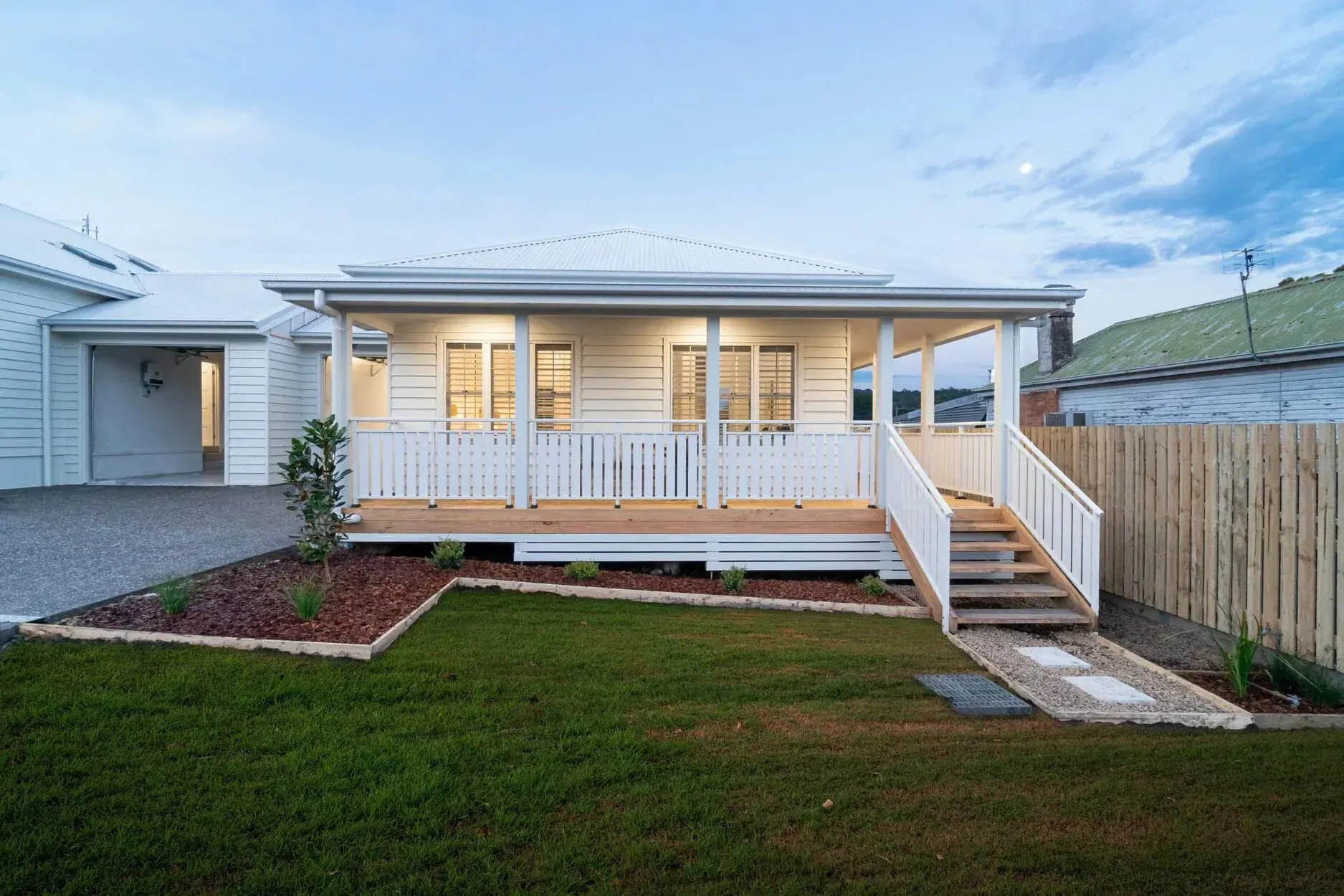
Case study
The site was competing with itself. We gave every page one job in the decision.
Backyard Grannys had more than a decade of experience, 1,000+ completed projects and plenty of content. But organic traffic had been declining for 12 straight months. The answer was not more content. It was a clearer search experience from first question to quote request.
The challenge
Over years of publishing, Backyard Grannys had accumulated pages with overlapping purposes. Several were competing for the same queries. Others answered useful questions but had no clear relationship to the commercial pages they were meant to support. At the same time, the legacy WordPress build created technical friction across site speed, crawling, internal linking and on-page optimisation.
The result was not simply declining rankings. The search journey itself had become unclear. A customer researching council approval could land on a page trying to sell a build. A comparison page could compete with a service page. Several URLs could ask Google to rank them for the same intent.
Backyard Grannys was not short of content. It was short of clear roles for that content.
- 12 straight months of organic traffic decline
- Multiple pages competing for the same queries
- Research content with no clear relationship to the commercial pages
- A legacy WordPress build constraining on-page optimisation and Core Web Vitals
The result
Twelve months of organic decline reversed, and qualified leads grew faster than traffic.
Lead growth is the commercial result. Traffic and rankings show how it was reached.
- +112%
- Qualified leads Published case study
- +134%
- Organic traffic vs pre-engagement · published case study
- +228%
- Top-3 ranking keywords Published case study
The insight
More content would have made the problem worse.
The opportunity was to stop treating every relevant keyword as a reason to create another page. Instead, each important search intent needed one clear page, one defined job and one logical next step.
Research content could answer questions. Comparison content could help people weigh options. Commercial pages could focus on people ready to enquire. Once those roles were clear, the pages could support one another instead of competing with one another.
The strategy
Build the foundation. Map the decision. Give every page one job.
- Fix the foundation first.Before expanding the content programme, we addressed the technical constraints in the existing WordPress build: site speed, crawl efficiency, internal linking, duplicate variants and on-page structure.
- Rebuild around how buyers decide.The content architecture was reorganised around three broad customer needs: research and inspiration (designs, ideas and early questions); comparison and process (council approval, cost, trade-offs and how granny flat projects work); and quote intent (location and service pages for people actively looking for a builder).
- Give every page a single role.Cannibalising pages were merged or repurposed. Remaining pages were aligned to one clear intent rather than trying to educate, compare and convert in the same scroll.
The decision
One decision. Different pages doing different jobs.
- Research and inspiration“Do I need council approval?” · “Granny flat designs”
- Comparison and process“How much does a granny flat cost?” · “What are the trade-offs?”
- Quote intent“Granny flat builder Newcastle” · “Get a quote”
After a run of bad experiences with other competitors, Firewire were able to deliver results, doubling our organic leads, and have been a pleasure to work with. We highly recommend.
 Simon BrownMarketing Manager, Backyard Grannys
 What we did
Technical foundations. Improved Core Web Vitals, crawl efficiency, canonicalisation, internal linking and structured data so later content work had a stable foundation.
Content architecture. Rebuilt the site into connected topic clusters around designs and inspiration, approval, cost and process, and quote-intent services.
Intent alignment. Merged or repurposed competing pages and gave surviving pages a clearer role in the customer decision.
Search experience. Removed unnecessary conversion pressure from research content, gave comparison pages room to handle trade-offs honestly and simplified the journey on high-intent pages.
The takeaway
The lead growth did not come from sending more traffic to the same form.
Organic sessions grew from about 5.5k to 8.5k a month. The stronger commercial result was 112% growth in qualified leads, and that happened because the website became clearer about what each page was meant to do.
Research pages could help people discover and understand. Comparison pages could support consideration. Quote-intent pages could focus on customers ready to act. The growth came from matching the right search to the right page, then letting that page do one job well.
More work
 Legal Burke Mead Lawyers Less content, greater focus around the work the firm wanted to grow. SEO & search performance · Content & search experience
  Legal Hamilton Janke Lawyers Strong internal writing given clearer search direction. SEO & search performance · Content & search experience